Strata Motor
Choosing the right Industrial Motor is a technical decision, not a simple purchase. Motor performance affects production speed, energy costs, maintenance, and equipment life. The International Energy Agency reports that electric motor systems consume roughly half of global electricity. In industrial facilities, the U.S. Department of Energy identifies motor-driven equipment as a major share of electricity use. Even a small efficiency difference can become expensive across thousands of operating hours.
The best choice begins with the application. Examine load type, starting torque, duty cycle, speed range, ambient temperature, and available power. A conveyor carrying heavy materials needs different torque behavior from a centrifugal pump. Check the motor nameplate carefully. Voltage, frequency, rated current, enclosure design, and insulation class must match the operating environment. Dust, moisture, heat, and chemical exposure can shorten service life quickly. The IEC 60034-30-1 standard provides a useful framework for comparing motor efficiency classes, including IE3 and IE4 designs.
Do not choose by price alone.
A cheaper motor may consume more power or require frequent repairs. However, the highest efficiency class is not automatically the best answer. Oversizing can reduce efficiency under light loads, while an undersized motor may overheat during peak demand. Total cost of ownership offers a clearer comparison. Include purchase price, electricity consumption, controls, spare parts, and downtime. Real plant conditions can be messier than specification sheets suggest. That is why measured load data, maintenance records, and advice from qualified engineers should support the final selection.
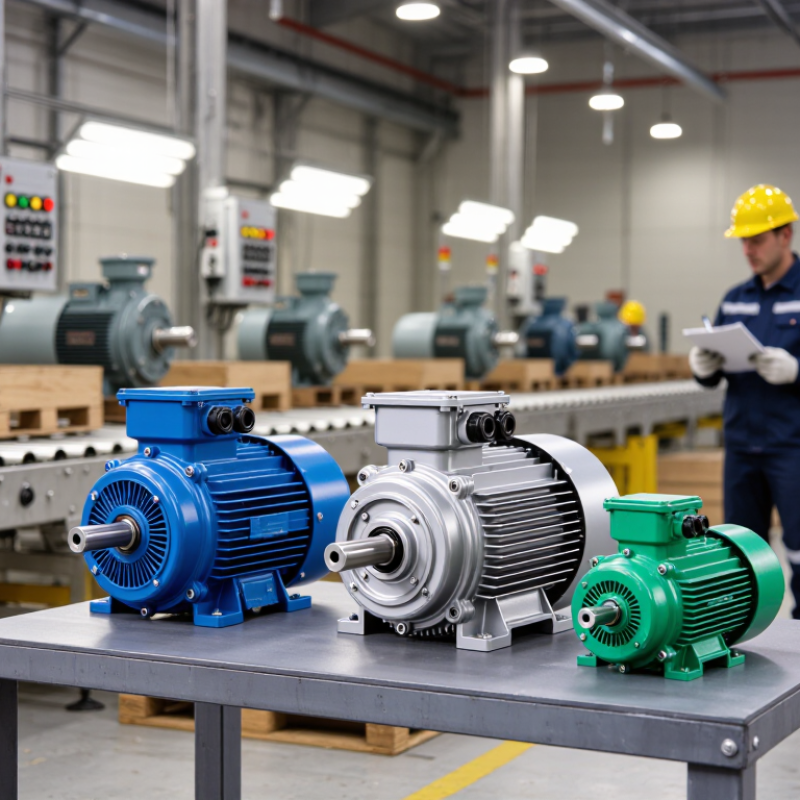
Choosing an industrial motor begins with understanding how each type converts electrical energy into motion. The common squirrel-cage induction motor creates a rotating magnetic field in its stator. This field induces current in the rotor, producing torque without brushes or permanent magnets. It is rugged, affordable, and suitable for pumps, fans, compressors, and conveyors.
A synchronous motor rotates at the magnetic field’s exact speed. Its speed remains stable under changing loads, although starting equipment may be more complex. Permanent-magnet synchronous motors can deliver high efficiency and compact torque, but they require careful control and thermal management.
DC motors provide simple speed control, yet brushes demand maintenance. Servo motors add feedback, allowing precise positioning in robotics and packaging equipment.
Efficiency deserves serious attention. The International Energy Agency estimates that motor-driven systems consume about 53% of global electricity. The U.S. Department of Energy also reports that motor systems represent more than half of industrial electricity use in American facilities.
These figures make small efficiency differences expensive over years. A practical selection process examines load torque, starting current, operating speed, duty cycle, ambient temperature, and enclosure requirements.
I have seen motors oversized “for safety” and then run inefficiently at light loads. That choice feels cautious, but it can increase energy waste and reduce control quality. Variable-speed drives help induction motors match output to demand, especially in centrifugal pump applications.
However, harmonics, cooling loss, and drive compatibility still require testing. No calculation is perfect. Field measurements often reveal what the specification sheet misses.
Power describes the work rate, while speed controls how quickly the shaft turns. Torque provides the twisting force needed to start and move a load. A conveyor carrying heavy boxes may need modest speed but high starting torque.
I have seen motor selections fail because engineers calculated running power only. Starting loads, friction, and sudden jams were ignored. Measure the actual load when possible. Record shaft speed, acceleration time, and operating temperature. A motor running near its limit may overheat, even when its nameplate rating appears adequate. Allow a sensible margin, but avoid excessive oversizing. It can increase costs and reduce efficiency.
Tips: Check the duty cycle carefully. Continuous operation differs from short, repeated cycles. For example, a hoist may run for two minutes, stop for eight, and repeat all day. This pattern affects heating and required motor capacity. Review ambient temperature, dust, moisture, and available voltage before final selection. Ask whether the load changes during production. It often does. My own early estimates were too optimistic when conditions seemed stable. Real equipment is rarely that predictable. Test assumptions against measured data, and document every value used in the calculation.
How to Choose the Best Industrial Motor for Your Needs?
Match Motor Characteristics to the Application Environment
Motor selection should begin with the working environment, not the nameplate alone. The International Energy Agency reports that motor-driven systems consume nearly half of global electricity. In industrial facilities, the wrong motor can waste energy through overheating, frequent cycling, or poor load matching. A conveyor moving heavy materials needs high starting torque. A ventilation fan usually needs stable speed and efficient continuous operation. These are different duties.
Inspect the site carefully. Dust, moisture, chemicals, altitude, and ambient temperature all affect motor life. An enclosed motor with a suitable IP rating can resist dust and water exposure. A washdown area demands more protection than a dry assembly room. Check insulation temperature limits, cooling method, and bearing requirements. IEC 60034-5 provides a useful framework for enclosure protection. Small details matter.
The U.S. Department of Energy identifies motor systems as major industrial electricity users. Efficiency, however, is not only about rated efficiency. Consider the duty cycle, load profile, starting frequency, and control method. Variable-speed control may reduce fan and pump energy, especially under changing demand. Yet it can introduce harmonics, heat, or compatibility problems. I have seen technically efficient motors perform poorly after an application changed. Recheck the assumptions. Measure actual load current, temperature, and vibration before finalizing the specification.
| Application Environment or Requirement | Recommended Motor Type | Typical Power Range | Important Characteristics | Recommended Protection and Configuration | Typical Applications |
|---|---|---|---|---|---|
| General-purpose industrial duty | Three-phase squirrel-cage induction motor | Approximately 0.75–315 kW | Reliable construction, moderate starting torque, low maintenance, and suitability for continuous-duty operation | IP55 or higher where dust and water exposure is expected; Class F insulation is commonly used; select IE3 or IE4 efficiency where applicable | Pumps, fans, conveyors, compressors, machine tools, and process equipment |
| Variable-speed operation | Inverter-duty induction motor or permanent-magnet motor | Approximately 0.75–500 kW | Designed for frequent speed changes, improved control, and compatibility with a variable-frequency drive (VFD) | Use suitable winding insulation, insulated bearings or shaft grounding for larger VFD-driven motors, and verify the required speed range and cooling method | Extruders, conveyors, mixers, machine tools, HVAC systems, and automated production lines |
| High starting torque or heavy starting load | High-torque squirrel-cage induction motor or wound-rotor motor | Approximately 15–1,000 kW | High locked-rotor torque, controlled acceleration, and the ability to withstand repeated or prolonged starting conditions | Check starting current, acceleration time, thermal capacity, coupling limits, and the available short-circuit capacity of the supply | Crushers, conveyors, hoists, elevators, compressors, and loaded pumps |
| Wet, dusty, or washdown areas | Totally enclosed fan-cooled (TEFC) motor with enhanced enclosure protection | Approximately 0.37–315 kW | Enclosed construction, corrosion resistance, sealed bearings, and suitable surface treatment for the environment | Select an appropriate IP rating; IP65 or higher may be required for demanding washdown conditions, subject to the application and enclosure design | Food processing, wastewater treatment, outdoor conveyors, chemical handling, and agricultural facilities |
| Hazardous or potentially explosive atmosphere | Certified hazardous-area motor | Application-dependent; commonly 0.37–500 kW | Certified enclosure, controlled surface temperature, and construction matched to the specified gas or dust classification | Confirm zone or division, equipment group, temperature class, protection method, and certification requirements before purchase | Oil and gas facilities, solvent processing, grain handling, paint plants, and chemical production |
| High ambient temperature or limited cooling | Motor with suitable thermal rating and independent or forced ventilation | Approximately 0.75–500 kW | Adequate thermal margin, temperature-rated insulation, and cooling capacity at low speed or high load | Verify ambient temperature, altitude, derating requirements, ventilation clearance, winding temperature sensors, and bearing temperature monitoring | Furnace auxiliaries, compressor rooms, process plants, outdoor installations, and high-temperature production areas |
| Low-noise or vibration-sensitive installation | Low-noise balanced induction motor or permanent-magnet motor | Approximately 0.37–250 kW | Low vibration, accurate balancing, suitable bearing arrangement, and stable speed control | Specify vibration limits, flexible coupling alignment, proper foundation stiffness, and acoustic requirements | HVAC equipment, laboratory systems, precision machinery, clean production areas, and building services |
| Energy-efficient continuous operation | High-efficiency IE3 or IE4 induction motor; permanent-magnet motor for suitable variable-speed systems | Approximately 0.75–1,000 kW | Reduced electrical losses, improved lifecycle economics, and good performance at the expected operating load | Compare full-load and part-load efficiency, operating hours, electricity cost, duty cycle, and applicable efficiency regulations | Fans, pumps, compressors, cooling systems, and continuously operating process machinery |
| Frequent starts, stops, reversing, or braking | Dynamic-duty induction motor or servo motor | Approximately 0.1–250 kW | High permissible acceleration frequency, rapid response, accurate positioning where required, and adequate thermal capacity | Evaluate duty cycle, inertia, braking energy, peak torque, encoder requirements, gearbox compatibility, and motor cooling | Robotics, packaging machines, indexing systems, cranes, material handling, and automated assembly equipment |
How to Choose the Best Industrial Motor for Your Needs?
Choosing an industrial motor requires more than matching horsepower to a machine. I compare efficiency across the actual load range, not only at full load. A motor running at 60% load may waste less energy than an oversized unit. Check rated efficiency, power factor, duty cycle, and expected operating hours. Small percentage differences become significant in pumps, conveyors, and compressors that run continuously. Measure current during normal production when possible. A catalog value can look precise, yet real conditions may differ.
Control method also affects performance. Fixed-speed motors suit equipment with steady demand and simple operation. Variable-frequency control supports gradual acceleration, adjustable speed, and reduced mechanical stress. It can also create heat, electrical noise, or insulation stress if the system is poorly matched. Soft starters reduce starting current, but they do not provide full speed control. Feedback devices may improve positioning, though they add wiring and maintenance. Control is not decoration.
Installation details often decide whether efficiency survives. Confirm voltage, phase, mounting dimensions, shaft size, cooling clearance, and enclosure protection. Dusty rooms may require stronger protection than clean production areas. Leave space around the motor for airflow and inspection. Use suitable cables, grounding, and overload protection. My early selections sometimes focused too heavily on efficiency ratings. That was a mistake. A highly efficient motor can still perform poorly if alignment, ventilation, or control settings are wrong. Check these details before approving the purchase.
Compare efficiency, control methods, and installation needs for a typical 11 kW, four-pole, 50 Hz motor.
Higher efficiency classes reduce electrical losses during continuous operation. The values shown are representative full-load efficiencies based on IEC 60034-30-1 ratings for a 4-pole, 11 kW motor.
DOL: simplest and lowest-cost option, but typically produces starting current of about 5–8 times rated current. Soft starter: reduces starting stress. VFD: provides adjustable speed and process control.
Allow for overload protection, correct grounding, ventilation, cable sizing, and enclosure requirements. VFD installations also require compatible motor insulation, EMC practices, and drive parameter setup.
Use the motor nameplate and the applicable local electrical code for final selection. Actual efficiency varies with motor speed, load, voltage, frequency, and operating conditions.
How to Choose the Best Industrial Motor for Your Needs?
Purchase price rarely shows the real cost. The U.S. Department of Energy reports that motor-driven systems consume about 70% of industrial electricity. A small efficiency difference can therefore affect monthly bills for years. Compare full-load efficiency, operating hours, energy tariffs, installation labor, and expected service life. The International Energy Agency has estimated that electric motor systems use roughly 46% of global electricity. Efficiency deserves serious attention.
Maintenance and safety also shape total ownership cost. Check bearing access, lubrication intervals, enclosure protection, vibration limits, and spare-part availability. A dusty workshop may need a sealed enclosure. A pump room may require stronger corrosion protection. Review overload behavior and thermal protection with a qualified engineer. Standards such as IEC 60034 and NFPA 70B provide useful technical and maintenance guidance. Yet standards do not replace site measurements.
Tips: Record temperature and vibration during normal operation. Ask for tested efficiency data, not only catalogue claims. Calculate downtime costs before choosing a cheaper motor. Inspect alignment after installation. I have seen an efficient motor underperform because poor coupling alignment created heat and repeated bearing failures. That mistake is easy to miss. A practical decision should include a five-year cost model, maintenance access, worker safety, and uncertain operating conditions.
Its stator creates a rotating magnetic field. This field induces current in the rotor and produces torque without brushes.
A squirrel-cage induction motor often suits these machines. It is rugged, affordable, and practical for many fixed-speed applications.
Choose one when stable speed matters under changing loads. Starting equipment may be more complex, so installation planning is important.
It can provide high efficiency and compact torque. Careful control and thermal management remain necessary during demanding operation.
Check load torque, starting current, speed, duty cycle, temperature, enclosure protection, and mounting dimensions. Site conditions matter.
Dust and water can shorten motor life. Select suitable enclosure protection, insulation limits, cooling, and bearing arrangements for the location.
It can match motor output to changing demand. This is especially useful for centrifugal pumps and ventilation fans.
Poor compatibility may cause harmonics, heat, electrical noise, or insulation stress. Testing is still needed.
Not always. An oversized motor may run lightly loaded, waste energy, and provide weaker control. I have made that assumption before.
Confirm voltage, phase, shaft size, mounting, airflow, grounding, cables, and overload protection. Alignment matters too. Small errors matter.
Choosing the best Industrial Motor requires more than comparing rated power. First, understand the differences among common motor types and how their operating principles affect performance, control, and suitability for specific tasks. Clearly define the application’s power, speed, torque, starting, and duty requirements, including whether the motor will run continuously, intermittently, or under frequent load changes.
The operating environment is equally important. Temperature, moisture, dust, vibration, hazardous conditions, and available installation space can determine the required enclosure, protection level, cooling method, and mounting arrangement. Buyers should also compare energy efficiency, speed-control options, wiring and installation needs, and compatibility with existing equipment. Finally, evaluate the total cost of ownership, including purchase price, energy consumption, maintenance, spare parts, safety features, and expected service life. A well-selected motor should deliver reliable performance, manageable maintenance, and long-term value rather than simply meeting the initial technical specifications.
