 Strata Motor
Strata Motor
Strata Motor
Choosing Electric Motor Parts for global sourcing is not a simple price comparison. It requires practical judgment, engineering knowledge, and disciplined supplier verification. A stator, rotor, bearing, or insulation component may look acceptable in a catalog, yet fail after heat, vibration, or repeated starting cycles. Small dimensional errors can create audible noise, excess current, or premature bearing wear.
Dr. Thomas A. Lipo, a respected motor-design authority, emphasizes a critical principle: “A motor should be designed for its application, not merely for its rating.” That principle also guides component sourcing. Buyers must connect each Electric Motor Parts specification with real operating conditions, including voltage, torque, speed, duty cycle, ambient temperature, and enclosure requirements. A warehouse fan and an industrial compressor cannot share the same assumptions.
Look closely.
This guide examines how to compare materials, tolerances, certifications, testing records, and supplier capability across international markets. It also considers communication risks, packaging details, lead times, and traceability. Experienced buyers know that the cheapest quotation may hide costly rework. Still, no checklist is perfect. Supplier data can be incomplete, and laboratory results may not represent field conditions. Careful sourcing therefore combines documented evidence with sample testing, technical questions, and honest reflection after every purchase.
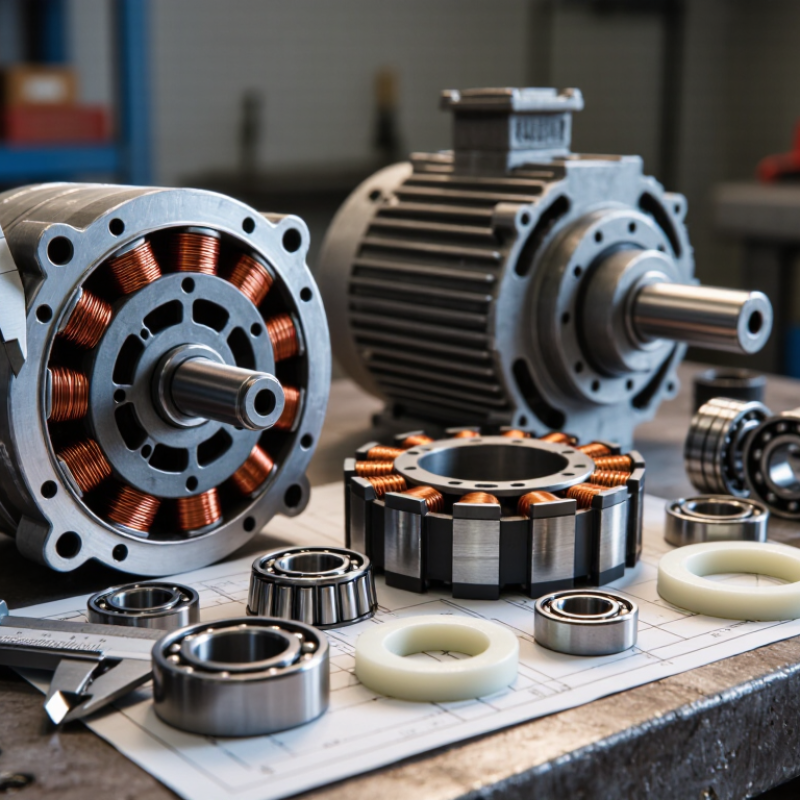
Before sourcing electric motor parts, define the motor’s real working conditions. Rated power alone is not enough. Record voltage, frequency, phase, speed, starting method, and expected torque. Describe the driven equipment too. A conveyor, pump, and compressor create different load patterns.
Think about the environment. Note ambient temperature, humidity, dust, corrosive vapors, altitude, and installation position. An outdoor motor may need a higher ingress protection rating than an indoor unit. Check insulation class and cooling method as well. These details affect bearings, fans, seals, terminal boxes, and winding materials.
Do not ignore operating cycles. State whether the motor runs continuously, starts frequently, reverses direction, or faces sudden overloads. A duty cycle can change the required rotor, shaft, coupling, and thermal protection. Include allowable vibration and noise levels when precision matters. Small differences become expensive later.
I have seen purchasing teams request “standard” parts without defining tolerances. That usually creates avoidable revisions. Measure shaft diameter, keyway size, mounting dimensions, and bearing seats carefully. Attach drawings, inspection points, and test requirements to every inquiry. Keep records of temperature-rise tests, insulation resistance, material certificates, and dimensional reports.
Some assumptions may be wrong. Recheck them.
For global sourcing, convert every requirement into clear, measurable language. Avoid vague terms such as “heavy duty” or “high quality.” Specify values, test methods, acceptable limits, and documentation formats. A supplier can only quote reliably when the operating conditions are visible.
Use the following engineering requirements and operating-condition data to define compatible electric motor parts before requesting quotations from global suppliers.
| Application Profile | Typical Motor Type | Rated Output | Supply Requirements | Typical Speed | Approximate Rated Torque | Operating Duty | Starting Requirement | Ambient Conditions | Protection and Insulation | Mounting and Part Requirements | Key Sourcing Checkpoints |
|---|---|---|---|---|---|---|---|---|---|---|---|
| Conveyor System | Three-phase squirrel-cage induction motor | 2.2–15 kW | 380–415 V, 50 Hz or 460 V, 60 Hz |
1,450–1,780 rpm | 14–96 N·m | S1 continuous | High starting torque; direct-on-line or variable-frequency drive | −10 to 40 °C; indoor or sheltered installation | IP55 minimum; Class F insulation is commonly specified | Flange or foot mounting; verify shaft diameter, keyway, frame size, bearings, and terminal box position | Confirm belt or gearbox load, service factor, brake requirement, overload duration, and local voltage frequency |
| Industrial Pump | Three-phase induction motor or premium-efficiency motor | 5.5–75 kW | 380–415 V, 50 Hz or 440–480 V, 60 Hz |
1,450–2,980 rpm | 18–240 N·m | S1 continuous | Normal starting torque; soft starter or variable-frequency drive may be used | 0–40 °C; humidity and splash exposure depend on installation | IP55 or higher; Class F insulation; anti-condensation heater may be needed in humid areas | IEC or equivalent frame; confirm pump coupling, vertical or horizontal mounting, and mechanical seal arrangement | Match motor power to pump head, flow rate, fluid density, speed, efficiency, and minimum flow conditions |
| Cooling Fan | Single-phase capacitor motor or three-phase induction motor | 0.18–7.5 kW | 220–240 V, 50 Hz or 220–277 V, 60 Hz |
900–2,900 rpm | 0.6–25 N·m | S1 continuous | Low to moderate starting torque; quiet acceleration preferred | −20 to 50 °C; dust and moisture depend on fan enclosure | IP44–IP55; Class F insulation for elevated temperature environments | Short or extended shaft; verify airflow direction, rotation direction, shaft length, and mounting bracket | Specify required airflow, static pressure, noise limit, rotational speed, thermal protection, and balancing requirements |
| Compressor | Three-phase induction motor designed for high starting load | 7.5–110 kW | 380–415 V, 50 Hz or 460–480 V, 60 Hz |
1,470–2,980 rpm | 24–350 N·m | S1 continuous | High locked-rotor torque; star-delta starter, soft starter, or variable-frequency drive | 5–40 °C; ventilated machinery room recommended | IP55 minimum; Class F insulation; suitable bearing arrangement for belt or direct coupling | Foot mounting is common; confirm shaft extension, pulley load, coupling, bearing type, and cooling method | Check compressor starting torque, unloaded start system, cyclic operation, overload relay setting, and vibration limits |
| Hoist or Crane Drive | Brake motor or inverter-duty induction motor | 3–45 kW | 380–415 V, 50 Hz or 440–480 V, 60 Hz |
700–1,500 rpm | 19–610 N·m | S3 intermittent S4 cyclic |
Very high starting torque; controlled acceleration and rapid braking | −10 to 40 °C; possible dust, vibration, and outdoor exposure | IP55–IP66; Class F or H insulation; fail-safe electromagnetic brake may be required | Brake torque, brake voltage, shaft and flange dimensions, encoder, bearings, and manual release must be specified | Define load mass, lifting speed, duty cycle, starts per hour, acceleration time, holding brake torque, and emergency stop behavior |
| Machine Tool Spindle | Permanent-magnet synchronous motor or high-speed induction motor | 3–30 kW | 200–400 V DC bus via drive or application-specific inverter supply |
3,000–24,000 rpm | 1.2–95 N·m | S1/S6 continuous | Fast acceleration; precise speed and position control | 15–35 °C; low vibration and controlled contamination | IP54–IP65; Class F insulation; shaft grounding may be required with inverter operation | High-speed bearings, encoder or resolver, balancing grade, cooling jacket, shaft runout, and tool-interface dimensions | Specify constant-torque and constant-power ranges, maximum speed, radial load, axial load, thermal limits, and drive compatibility |
| Outdoor Agricultural Equipment | Three-phase induction motor or permanent-magnet motor | 1.5–30 kW | 230–400 V, 50 Hz or 460 V, 60 Hz |
1,450–3,000 rpm | 5–190 N·m | S1 continuous S2 intermittent |
High torque at low speed; frequent starts and load changes | −20 to 50 °C; rain, mud, dust, vibration, and temperature cycling | IP65 or higher; Class F insulation; corrosion-resistant coating and sealed bearings preferred | Shock-resistant housing, reinforced shaft, cable glands, connector sealing, and mounting orientation must be verified | Check ingress protection, vibration rating, wash-down exposure, altitude, cable flexibility, and cold-start performance |
| Hazardous-Area Process Equipment | Certified enclosed induction motor | 1.1–90 kW | 380–415 V, 50 Hz or 440–480 V, 60 Hz |
1,450–2,980 rpm | 3.5–290 N·m | S1 continuous | Controlled starting current; starter and protection must suit the area classification | −20 to 40 °C; flammable gas, vapor, or combustible dust may be present | Explosion-protection certification required; enclosure, temperature class, and IP rating must match the site | Certified cable entries, terminal enclosure, grounding arrangement, bearings, and surface temperature limits are critical | Provide hazardous-area zone or division, gas or dust group, temperature class, ambient range, altitude, and certification requirements |
| Servo Positioning Axis | Permanent-magnet AC servo motor | 0.2–15 kW | 200–400 V AC class drive or 48–96 V DC class system |
1,000–6,000 rpm | 0.3–95 N·m | S5 intermittent S6 cyclic |
High peak torque; rapid acceleration, deceleration, and reversal | 0–40 °C; low dust and controlled vibration preferred | IP65 commonly used; Class F insulation; absolute or incremental encoder required | Confirm flange, shaft, brake, feedback connector, encoder resolution, cable length, and drive tuning compatibility | Define continuous torque, peak torque, inertia ratio, acceleration time, positioning accuracy, backlash, and regenerative energy |
Record voltage, frequency, phase, speed, starting method, torque, and rated power. Describe the driven equipment clearly. A pump behaves differently from a conveyor. Measure shaft diameter, keyway size, bearing seats, and mounting dimensions. Measure twice.
Temperature, humidity, dust, corrosive vapors, altitude, and installation position affect part selection. Outdoor equipment may need stronger protection. Cooling method and insulation class also influence fans, seals, bearings, and winding materials. Assumptions can fail.
Continuous running, frequent starts, reversing, and sudden overloads create different thermal stresses. The duty cycle may change rotor, shaft, coupling, and protection requirements. Record allowable vibration and noise levels when precision matters.
Include measurable values, tolerances, test methods, and acceptable limits. Add drawings, inspection points, and documentation requirements. Avoid vague phrases such as “heavy duty.” Clear numbers produce more reliable quotations.
Inspect a sample shaft using calibrated tools. Check bearing seats, keyways, mounting holes, housing dimensions, and insulation resistance. Compare the actual part with approved drawings. Paperwork can look complete but still miss steel grade or coating thickness.
Request material certificates, dimensional drawings, test reports, production samples, and traceability records. Temperature-rise results and insulation tests are useful. Keep inspection records from raw material through final approval. Records prevent confusion later.
Build a landed-cost sheet for each supplier. Include unit price, tooling, packing, customs fees, duties, insurance, inspection, inland delivery, and currency changes. Carton size and gross weight matter. A small part can become costly.
Measure lead time from approved drawing to usable stock. Confirm material availability, production capacity, testing time, and transport schedules. Protect parts with moisture barriers and shock protection. Keep a controlled buffer for critical components. My estimate may be too optimistic. Recheck it.
Choosing Electric Motor Parts for global sourcing starts with a clear understanding of the motor’s requirements and operating conditions. Define power, voltage, speed, torque, duty cycle, temperature, load, environment, and expected service life before selecting components. Parts should then be matched with the motor’s technical specifications, dimensional requirements, material standards, and applicable international standards to support safe and reliable performance across different markets.
Supplier evaluation is equally important. Review manufacturing capability, quality-control systems, testing procedures, documentation, and product traceability. Compare total landed costs rather than unit prices alone, including tooling, packaging, transportation, duties, lead times, and potential logistics risks. Before placing a large order, validate samples under representative conditions and confirm compliance documents, inspection records, and consistency between samples and production batches. Finally, assess the supplier’s ability to provide stable capacity, technical communication, replacement support, and continuous quality improvement for long-term supply.
