What Are the Top Robotic Motor Manufacturers in China?

Time:2026-11-03 Author:Oliver
0%

China’s position in robotics is clear. Its position in robotic motors is harder to measure. The International Federation of Robotics reported 276,288 industrial robot installations in China in 2023, about 51% of global installations. The country’s operational stock reached roughly 1.8 million units. These figures come from IFR’s World Robotics 2024 report. They show the scale of demand, but they do not identify which motor suppliers lead. That distinction matters.

“China is the world’s largest market for industrial robots by far,” said Marina Bill, then president of the International Federation of Robotics. Her observation helps explain why motor makers compete so intensely there. A robotic motor must deliver controlled torque, smooth motion, and dependable performance through repeated cycles. Buyers also compare encoder accuracy, heat management, service access, and integration with servo drives. A motor can look impressive on a datasheet and still disappoint on a hot factory floor. Small details matter.

This overview examines leading Chinese manufacturers through those practical criteria, rather than treating market presence as proof of quality. Public rankings for robotic motors remain limited, and company claims are not always independently comparable. That is a real gap. Readers should verify specifications, certifications, and application references before selecting a supplier. The strongest choice depends on the robot’s payload, duty cycle, and motion profile—not just the brand name.
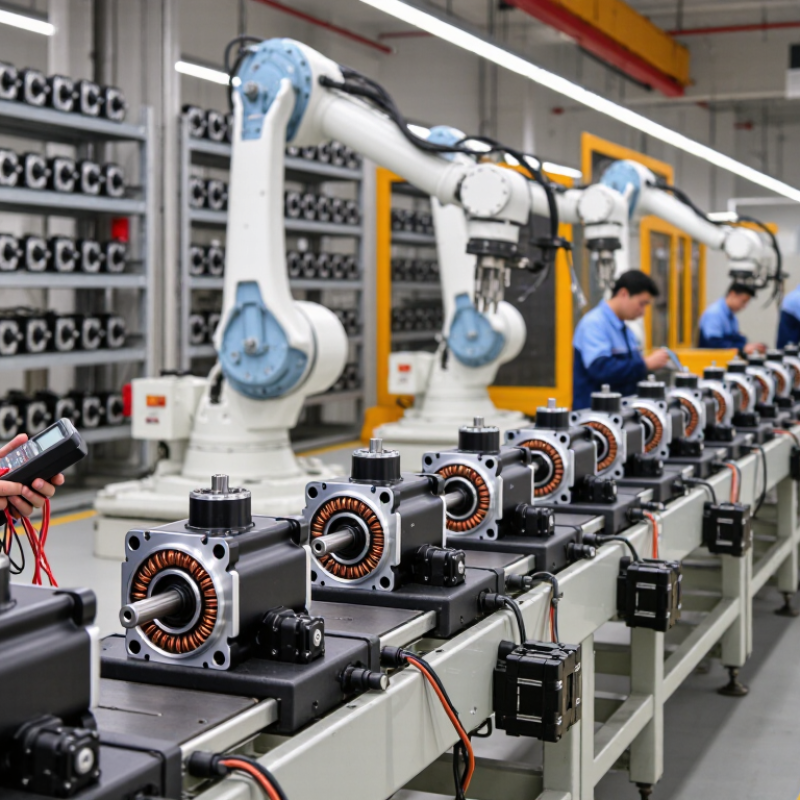
What Are the Top Robotic Motor Manufacturers in China?

Types of Motors Used in Robotics

Robots rely on different motor types because each joint faces a distinct load, speed, and accuracy requirement. The International Federation of Robotics reported 541,302 industrial robot installations worldwide in 2023, with 4.28 million units operating globally. That scale makes motor selection more than a component detail. Servo systems pair motors with feedback devices, helping robotic arms place parts precisely or follow smooth paths. Brushless DC motors are common where compact size, efficient operation, and controllable speed matter. Heat still matters.

Stepper motors move in fixed increments and can suit lighter mechanisms, such as camera mounts or small positioning stages. However, they may lose steps under sudden loads, so feedback can be important. Linear motors deliver direct, straight-line motion without a rotary-to-linear mechanism; torque motors provide high rotational force at low speeds. These options can reduce backlash, but they may raise cost or cooling demands. IFR’s World Robotics 2024 report measures robot installations, not motor shares, so it cannot identify a universal “best” motor type. In practice, engineers must match the motor to payload, duty cycle, control needs, and available space—and revisit assumptions after testing.

Key Criteria for Evaluating Robotic Motor Manufacturers

Evaluating a robotic motor manufacturer takes more than comparing rated power and unit price. The International Federation of Robotics reported 276,288 industrial robot installations in China in 2023, about 51% of global installations. Its World Robotics 2024 report also recorded 470 robots per 10,000 manufacturing workers in China. This scale makes consistent performance and production quality especially important. Ask for torque-speed curves, continuous and peak torque ratings, thermal-rise results, and test conditions. A peak figure alone can mislead. Check whether the motor maintains torque through the robot’s actual duty cycle, not just a brief test.

Request sample test records and traceability for key components. Compare encoder resolution, feedback compatibility, vibration, noise, and thermal behavior under realistic loads. For articulated joints, inspect backlash and repeatability; for mobile robots, check efficiency and heat in tight enclosures. Ask how suppliers handle calibration drift and product changes. Specific answers matter. I would also review delivery consistency, technical support, and spare-part availability, then validate samples on the intended controller and gearbox. A polished datasheet can hide gaps. No checklist catches every mismatch, and buyers should treat unverified claims cautiously. The most useful evidence is measured performance under conditions close to the finished robot’s real operating cycle.

What Are the Top Robotic Motor Manufacturers in China? - Key Criteria for Evaluating Robotic Motor Manufacturers

Evaluation Dimension What to Compare Evidence to Request Why It Matters
Motor type and application fit Servo, brushless DC (BLDC), or other motor designs; suitability for the robot axis, duty cycle, and control system. Product datasheets, recommended applications, and compatibility information for the drive and feedback device. Different robot axes have different requirements for speed, precision, torque, and control.
Continuous and peak torque Rated continuous torque and peak torque, including the duration allowed at peak output. Torque-speed curves, test conditions, and thermal limits for the specified model. Continuous torque relates to sustained operation; peak torque supports short acceleration or load events.
Speed and power range Rated speed, maximum speed, and output power across the intended operating range. Motor curves and clearly stated voltage, current, and cooling conditions. Published ratings are useful only when their test conditions match the intended application.
Position feedback and control Encoder or resolver type, feedback resolution, commutation method, and supported control modes. Feedback-device specifications, wiring diagrams, and drive compatibility documentation. Feedback quality and compatibility affect motion control, commissioning, and system integration.
Thermal performance and duty cycle Permitted operating temperature, insulation details, cooling method, and specified duty conditions. Thermal test reports, installation guidance, and continuous-duty ratings for the proposed configuration. Heat affects allowable output, service life, and whether a motor can sustain the required cycle.
Mechanical and environmental protection Dimensions, shaft and mounting details, bearing arrangement, and ingress-protection rating where specified. Dimensioned drawings and test documentation identifying the applicable IP rating under IEC 60529. The motor must fit the mechanism and suit the dust, moisture, and cleaning conditions at the installation site.
Drive and communication compatibility Available drive options, command interfaces, and supported industrial communication protocols. Interface manuals, protocol versions, configuration files, and confirmation of compatibility with the target controller. A compatible motor-drive-control combination can reduce integration time and commissioning risks.
Quality management and traceability Documented manufacturing controls, inspection processes, serial-number tracking, and corrective-action procedures. Current quality-system certificates, sample inspection records, and product traceability examples. Certificates and records help assess process control, but should be checked for scope, validity, and relevance to the product.
Reliability and validation Documented endurance, vibration, temperature, and electrical tests relevant to the application. Test methods, sample sizes, acceptance criteria, and results for the specific motor family. Test details make reliability claims more useful than unsupported service-life statements.
Customization and engineering support Options for shaft, connector, winding, brake, feedback, and mechanical-interface customization. Written specifications, design-change controls, sample approval process, and engineering response arrangements. Clear change control is important when a motor is customized or integrated into a new robot design.
Delivery and after-sales support Quoted lead time, spare-parts availability, warranty terms, and technical support coverage. Written delivery commitments, warranty conditions, service contacts, and parts-support terms. Support and replacement-part availability affect maintenance planning and production continuity.

Compare manufacturers using the same application requirements and test conditions. No universal specification threshold applies to every robotic motor; final selection should be based on the robot’s load, motion profile, environment, and control system.

Leading Robotic Motor Manufacturers in China

China’s robotic motor sector is expanding alongside a large automation market. The International Federation of Robotics reported 276,288 industrial robots installed in China in 2023, representing 51% of global installations (World Robotics 2024). This figure measures robot installations, not motor sales, but it signals substantial demand for reliable servo and joint-drive components.

Leading manufacturers in China typically serve different needs: compact servo motors for fast pick-and-place arms, frameless torque motors for direct-drive joints, and integrated motor units for space-limited equipment. Buyers should compare continuous torque, peak torque, thermal performance, encoder resolution, and test conditions. A motor rated for high peak torque may still overheat during repeated cycles. Details matter.

A useful supplier assessment includes production traceability, sample testing, and support for tuning the motor with the intended drive and reducer. Ask for torque-speed curves and temperature-rise data under realistic duty cycles, not just catalog ratings. That’s practical. Independent comparisons are not always easy to find, and published specifications may use different test methods. Verify them with application-specific trials before making a production decision.

Robotic Motor Types: Typical Speed Ranges

This illustrative comparison shows broad operating-speed ranges for motor types commonly used in robotics. Actual speeds depend on the motor design, gearing, load, and operating conditions; the chart does not rank manufacturers.

Robotic Motor Technologies and Product Capabilities

Robotic motor manufacturers in China offer several technologies for different motion tasks. Brushless servo motors suit joints that need accurate speed and position control. Stepper motors can serve lighter axes, though they may lose synchronisation under sudden loads. Frameless torque motors fit compact joints where low backlash and direct drive matter. The right choice depends on the robot’s payload, cycle time, and workspace.

Product capability is more than rated power. Buyers should compare continuous and peak torque, encoder resolution, winding temperature limits, and motor inertia. A joint that lifts a metal part repeatedly may need stronger thermal management than its brief peak-load figure suggests. Integrated drives can reduce wiring and cabinet space, but they may make repairs less straightforward. Heat is real.

Practical evaluation should include test data at the intended voltage and duty cycle. Ask how torque changes with speed, and whether feedback remains stable during quick reversals. Check shaft dimensions, connector placement, and gearbox compatibility before building a prototype. Datasheets rarely capture every installation issue. That gap deserves attention. Suppliers may provide customization, but engineering teams should confirm tolerances and validation methods in writing, then test a sample under realistic motion profiles.

Applications and Market Trends in China’s Robotics Industry

China’s robotics industry is expanding from automotive and electronics plants into warehouses, food processing, and smaller workshops. Each setting places different demands on a motor. A welding arm needs stable torque and repeatable positioning, while a mobile warehouse robot benefits from compact, efficient drive units. Small details matter.

Servo motors remain common in articulated robots because they support precise speed and position control. Collaborative robots often need lightweight motors with responsive torque, helping them move safely around people when paired with suitable sensing and control systems. In logistics, wheel motors and compact actuators help vehicles navigate narrow aisles and stop accurately at handoff points. The right choice depends on the full system, not a motor’s headline specifications.

Market interest is shifting toward higher power density, integrated drives, and improved energy efficiency. Domestic manufacturing capacity is also growing, though performance and consistency can still vary between suppliers and product ranges. Buyers should test motors under realistic loads, temperatures, and duty cycles before deployment. Catalog figures rarely tell the whole story. A motor that performs well in a laboratory may behave differently after a long shift, and that gap deserves more attention.

FAQS

What types of motors are used in robotic systems?

Brushless servo motors support precise speed and position control. Stepper motors can suit lighter axes, but sudden loads may disrupt synchronisation.

When are frameless torque motors useful?

They fit compact joints that need direct drive and low backlash. Check available space around the joint.

Which specifications should buyers compare?

Compare continuous and peak torque, encoder resolution, motor inertia, and winding temperature limits. Peak ratings alone can mislead.

Why is thermal performance important?

Repeated lifting can heat a motor beyond what a brief peak-load rating suggests. Heat matters.

What test data should suppliers provide?

Request torque-speed curves and temperature-rise data at the intended voltage and duty cycle. Test conditions vary.

How should a motor sample be evaluated?

Run it through realistic motion profiles, including quick reversals and repeated loads. One short test may miss problems.

What installation details should engineers check?

Confirm shaft dimensions, connector placement, and gearbox compatibility before building a prototype. Small mismatches can stall assembly.

Do integrated motor units always simplify maintenance?

They can reduce wiring and cabinet space, but repairs may become less straightforward. The trade-off deserves a closer look.

How can buyers assess a supplier?

Check production traceability, sample testing, and support for tuning the motor with its intended drive and reducer. Published specifications may use different methods.

Conclusion

This article explores the motor types that power modern robots, including motors designed for precise positioning, continuous rotation, and high-torque movement. It explains how manufacturers can be evaluated by factors such as performance, reliability, efficiency, customization, production capacity, and technical support. These criteria help buyers compare suppliers according to the demands of their robotic systems rather than relying on a single specification.

The article also surveys the capabilities found across China’s robotic motor manufacturing sector, from compact designs and precise motion control to integrated solutions for different operating environments. It considers how these technologies serve applications in industrial automation, service robotics, logistics, and other fields, while examining market trends such as growing demand for efficient, dependable, and adaptable components. Together, these topics offer a practical overview of how to assess a Robotic Motor and its manufacturer for current and emerging robotics needs.

Oliver

Oliver

Oliver is a seasoned marketing professional with a wealth of expertise in driving brand awareness and engagement. With a deep understanding of our company's product offerings, he consistently delivers high-quality content that enriches our professional blog. His insights not only shed light on......